Hey everyone, if you’ve ever messed around with hydraulic systems—whether you’re a gearhead fixing farm equipment, a mechanic servicing construction rigs, or a design engineer testing industrial machinery—you know quick couplings are the unsung heroes here. They let you hook and unhook hydraulic lines in seconds, no fumbling with wrenches or fluid spills (okay, mostly no spills). But here’s the thing: if your couplings aren’t flowing right, your whole system’s gonna suck. Last month, a client hit me up saying their new hydraulic crane was “being a slug” because their off-the-shelf couplings were killing flow. That’s why today I’m breaking down how we measure hydraulic quick coupling flow characteristics—stuff we actually use at our shop, no textbook jargon that makes your eyes glaze over. Hydraulic Quick Couplings
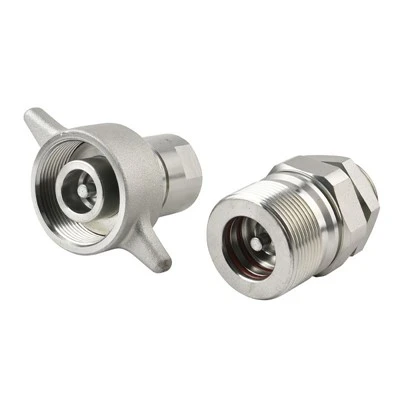
First off, let’s get on the same page about what “flow characteristics” even mean for these little bad boys. It’s not just “how much fluid moves through ’em”—it’s how it moves: pressure drop across the coupling, flow rate at different pressures, turbulence, how that changes when you cycle the coupling (connect/disconnect) a bunch, and even how it handles different fluid types (we see everyone from guys using hydraulic oil to folks running water-based fluids for food-grade setups). Mess any of that up, and you’ll get slow cycle times, overheated fluid, or even blown seals. Not fun.
Let’s start with the basics: you can’t measure flow without a test rig, duh. But I’m not talking about some lab-only monstrosity we built a compact, field-friendly rig that we also let clients borrow for testing their own stock. Here’s what’s in it: a constant-flow pump (we use a 10-gallon-per-minute (gpm) unit, but we swap ’em out for higher flows for big couplings), a pressure gauge on both the inlet (where fluid goes into the coupling) and outlet (where it comes out), a flow meter (digital, so you get real-time numbers, not old-school float gauges), a temperature probe (critical because fluid viscosity changes with temp—hot fluid is thinner, flows different), and a test section where we clamp the coupling in, tight, no leaks. And don’t forget a control valve to adjust flow so we can test at different pressures, from light residential stuff to heavy industrial loads.
Step one, let’s do a baseline without the coupling first. Why? Because we need to know how the fluid would flow if there was nothing in the way—this is our “ideal” number. We hook up the hoses straight, no coupling, set the pump to, say, 5 gpm, and record inlet pressure, outlet pressure, flow rate, and temp. Let’s say baseline pressure drop is 0.2 psi (that’s normal, just the hose itself). If we put a coupling in, and the pressure drop jumps to 2 psi? That’s the coupling robbing flow. Got it? We need that baseline to compare everything against—trust me, it’s the easiest way to spot garbage couplings fast.
Step two, mount the coupling and secure it. Super important: if it’s not sealed tight, you’re measuring leaks, not flow. We use our industrial clamps (we don’t trust hand-tightening for tests) and run a small flow for a minute to let the coupling seat—quick couplings have poppet valves that need to align right, seating takes 30 seconds, not 2. Then we lock the test rig, no wiggle room. The coupling’s size matters too—we test every coupling’s rated size: 1/4-inch, 3/8-inch, whatever. A 1/2-inch coupling that’s supposed to do 10 gpm? We’re gonna see if it actually hits that, not the 6 gpm some cheap brands claim.
Step three, adjust flow and track pressure drop. Now we start with low flow—say 1 gpm—to avoid surge pressure (that’s when fluid slams into a closed valve, can blow gauges). Then we crank it up in increments: 2, 5, 7, 10, 12, whatever the coupling’s max rated flow is. For each number, we wait 20 seconds for things to stabilize (no mid-test fluctuations), then write down: inlet pressure (P1), outlet pressure (P2), actual flow rate, and fluid temp. Pressure drop is just P1 minus P2—simple math, but that’s the big one. If pressure drop is under 10% of inlet pressure, that’s a good coupling. If it’s over 20%? Run. We had a client test a cheap import coupling last quarter—at 8 gpm, pressure drop was 4.7 psi, while our standard coupling was at 1.9 psi. No surprise, ours made their forklift lift 15% faster.
Wait, but there’s more than just straight flow. Turbulence is a big one—how? We use a visual flow cell sometimes, a clear section on the outlet side. If you see swirling, eddies, or bubbles (wait no, bubbles are bad air) or a rough, choppy flow? That’s turbulence, which kills efficiency and can erode the coupling’s internals over time. Premium couplings we supply (yeah, I’m gonna name-drop a little, but only ’cause it’s relevant) have smooth, contoured poppets and passages—no sharp corners that cause turbulence. The cheap stuff has straight, sharp cuts, so fluid slams around, creates that choppy flow. We rate turbulence on a 1-5 scale: 1 is glass-smooth, 5 is a washing machine in a hose. Anything over 3 is a no-go for us.
Also, we do cyclic testing—because quick couplings get connected and disconnected all the time. Last year, a construction company told us their couplings were failing after 2,000 connects; ours last 10k+. For cyclic testing, we hook up the rig to automate connecting/disconnecting 50 times an hour, over 8 hours a day, for 2 weeks. Every day, we check flow and pressure drop. If a coupling’s pressure drop goes up 15% after 1k cycles? That means the poppet’s wearing, seals are deforming, and soon it’ll leak or die. Our coupling’s cyclic flow drop is under 5% after 10k cycles—no joke, we’ve tested that.
Oh, and fluid viscosity! Hydraulic fluid is rated by ISO grades—think ISO 32, ISO 46, that’s how thick it is. Cold fluid (winter) is thicker, so flow is lower; hot fluid is thinner, flow is higher. We test with ISO 46, the most common, but sometimes test with ISO 68 for cold climates and even water-glycol for food-grade stuff. A coupling that works great with ISO 32 might choke on ISO 68, so we make sure our data covers different viscs—our product sheets actually have flow curves for ISO 32, 46, and 68, which most brands don’t do.
Wait, what about real-world testing? Lab rigs are great, but field is where the rubber meets the road (or the tire hits the pavement, if you will). We send small test sets to clients for 2 weeks—no charge, no strings, just feedback. Last summer, a logging company tried our 1/2-inch couplings on their skidders, which were using 12 gpm flow. Their old couplings had cycle times of 25 seconds to lift the grapple; ours got it down to 19 seconds. That’s 6 extra seconds per cycle, 100 cycles a day—way more productive. That’s the stuff numbers can’t always tell you, but when you measure it, it’s obvious.
A common mistake people make? Buying by price, not by flow rate. A lot of guys look at the coupling’s size (like 3/8-inch) and assume it’s good for whatever their pump’s flow is—no. A 3/8-inch coupling might be rated for 5 gpm, but if your pump is pushing 7 gpm, you’re gonna get that huge pressure drop we talked about, and your system will be starved. We always tell clients: match coupling size and internal passage design to your system’s flow. Our “high-flow” couplings have wider, rounded passages, so they don’t choke flow even at max rated pressure.
Another thing: pressure ratings. You can have a coupling that flows great, but if it can’t handle your system’s pressure, it’s useless. We test at 1.5x the coupling’s rated pressure to make sure it doesn’t deform and mess with flow. Last year, a mining client came to us with a coupling that worked at 3,000 psi but failed at 3,500, so they’d been losing flow at peak pressure. We sent them our couplings rated for 6,000 psi, and their flow stayed consistent even at max system pressure—game changer for their rock crushers.
So why does all this matter? At the end of the day, if you’re in the business where time is money, your hydraulic system’s flow is your bread and butter. Slow cycles mean lost production, overheated fluid means higher maintenance costs, and bad couplings mean headaches. We don’t just sell quick couplings—we sell the ones that actually flow like they’re supposed to, ’cause we’ve tested every single thing we put our name on.
If you’re tired of underperforming couplings that kill your system’s flow, hit us up to talk through your setup—whether you need a test to see if your current couplings are working, or you want to swap to ones that actually measure up. We don’t do pushy sales stuff—we just know our gear, and we know what works when you’re out in the field.
Banjo Fittings References:
Hydraulic Institute. (2020). Hydraulic Quick Coupling Performance Testing Standards.
International Organization for Standardization. (2018). ISO 16028: Hydraulic fluid power — Quick-release couplings — General specifications and tests.
Fluid Power Society. (2021). Flow Characteristics of Hydraulic Couplings for Mobile Equipment Applications.
Hutton, J. E. (2019). Hydraulic System Design: Flow Measurement and Performance Validation.
American National Standards Institute. (2020). ANSI/B93.7: Performance Requirements for Hydraulic Quick Couplings.
Cixi Poolke Hydraulic Pneumatic Co., Ltd.
Cixi Poolke Hydraulic Pneumatic Co., Ltd. is one of the most professional hydraulic quick couplings manufacturers and suppliers in China, also supports customized service. Please feel free to wholesale the newest hydraulic quick couplings made in China here from our factory. Quality products and reasonable price are available.
Address: #88 Zhengtong Road, Kandun Industrial Park315303, Cixi, Zhejiang, China
E-mail: contact@poolke.com
WebSite: https://www.poolkecouplings.com/
