When I first started as a disposable bipolar forceps supplier, I thought calibration was just a routine checkbox on the quality control list. Early on, I’d occasionally get messages from surgical teams saying, “The forceps aren’t cutting like they should” or “The current feels off during delicate procedures.” That feedback pushed me to dig deeper—because a tool designed for precision neurosurgery, orthopedics, or general surgery can’t be disposable and unreliable without proper calibration. Today, after years of refining our processes and walking alongside surgeons who use our forceps every day, I want to share what I’ve learned about calibrating disposable bipolar forceps: not as a technical chore, but as a critical step that keeps patients safe and surgeries on track. Disposable Bipolar Forceps
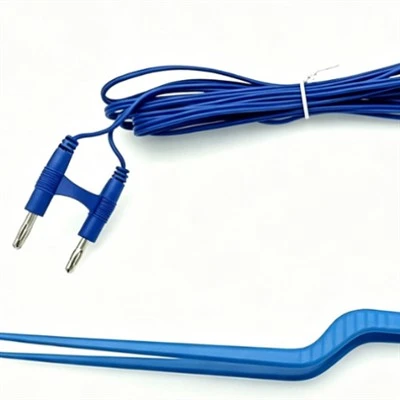
First, let’s get one thing straight: disposable bipolar forceps are different from reusable ones. Reusable tools have their calibration checked after autoclaving, after dozens of uses, and sometimes mid-procedure. Disposable ones—well, they’re designed for one single use, which means their calibration has to be locked in before they even leave our facility. That’s a responsibility I don’t take lightly. A bad set of disposable forceps can mean uneven tissue coagulation, accidental current leakage, or even unnecessary tissue damage during a procedure where every millimeter matters. Over the years, I’ve worked with our engineering team to build a calibration process that’s practical for our manufacturing line, but also aligns with what surgeons need to verify on their end, just to be sure.
Let’s start with the basics of how bipolar forceps work, because you can’t calibrate something if you don’t understand what’s supposed to be calibrated. Bipolar forceps deliver electrical current only between the two tips of the forceps, which means the tissue between the tips acts as the resistor in the circuit. The goal is to deliver a consistent, controlled amount of current (or power) to that tissue to seal blood vessels or cut through delicate tissue without overheating or underpowering. Calibration here means making sure that every forceps set leaves our facility delivering exactly that specified power, no more, no less—and that the electrical path between the two tips is clean and unobstructed.
Our calibration process happens in three key stages: in-line during manufacturing, final testing before packaging, and a post-packaging validation step. Let’s break that down.
In-line calibration is the first step, which happens right after the forceps tips are formed and the wiring is attached. We use a precision impedance tester here—nothing fancy, just a tool that measures the resistance between the two forceps tips. For most of our disposable bipolar forceps, we target an impedance range of 500 to 1500 ohms, which is the sweet spot for most surgical procedures. If the impedance is too low, that means the wiring is shorted somewhere, and current will leak before it reaches the tissue. If it’s too high, the current can’t flow properly, so coagulation is slow or ineffective. Our line operators are trained to spot these deviations immediately—we’ve cut back on bad units here by 90% just by making sure every forceps is checked before moving to the next step. That said, impedance alone isn’t enough; we also test the voltage and current output, because even if the resistance is correct, a faulty power source in the forceps handle can throw off the entire system. It’s like making sure a car’s battery is working even if the tires are properly inflated—they both need to be right for the vehicle to run.
Next is final calibration testing, which happens after the forceps are assembled and packaged in their sterile blister packs. Here, we use a specialized load simulator that mimics the resistance of human tissue. I’ve heard some suppliers skip this step, but that’s where mistakes happen. A plastic or metal probe might show good resistance, but tissue is a wet, conductive material—different enough that the calibration could be off when it’s actually used. Our load simulator uses a saline-soaked substrate with a resistance range of 500 to 1500 ohms, just like real soft tissue, and we apply a standard surgical current (usually between 1 and 5 amps, depending on the model) to make sure the forceps delivers the exact power we specify. We record every single test result for every lot of forceps—if a lot comes back with even a 5% deviation in power output, we scrap the entire batch. Early in my career, we had a small lot that slipped through because of a faulty load simulator; a neurosurgeon called us up saying the forceps burned through healthy tissue during a spinal procedure. I still remember that call. We recalled every unit, fixed the simulator, and now every test result is cross-checked by a senior engineer before the lot is released. That incident taught me that calibration isn’t just about numbers—it’s about trust. Surgeons rely on our products in life-or-death moments, so every unit has to be spot-on.
But here’s the thing: even if we calibrate perfectly at our facility, surgeons should do their own pre-use check, too. Sterile packaging can sometimes get damaged during shipping, which could affect the forceps tips or the wiring. Or, a storage environment with extreme temperature or humidity (while rare, it can happen in some operating rooms or supply closets) could throw off the calibration. So I always advise surgeons to do a quick on-site calibration check before using a new set of disposable bipolar forceps. It’s a simple step, takes 30 seconds, and it’s worth it for the peace of mind. What do we recommend? First, inspect the forceps tips: they should be aligned perfectly, no burrs, no rust, and no debris. Even a tiny burr on one tip can create an uneven electrical path, leading to inconsistent current. Then, if the surgical suite has a bipolar current tester (most modern ones do), run a quick test: open the forceps tips, place them on the tester’s two probes, and activate the current. The tester should display the power output, and it should match the label on the forceps packaging. If it’s off by more than 10%, don’t use that unit. I’ve seen surgeons skip this step because they assume disposable is “pre-tested,” but that 30 seconds can save a lot of hassle during a procedure.
Now, let’s talk about common calibration mistakes we see, both from our team and from end users. The biggest one I see is mixing up different models of forceps. We make forceps for different procedures: some are for microsurgery (very fine tips, low power), some are for orthopedic procedures (thicker tips, higher power). If a surgeon accidentally uses a microsurgical forceps rated for 1 amp on a heavy orthopedic coagulation, the calibration is going to be off because the tool isn’t designed for that power level. Another mistake is not accounting for the generator settings. Bipolar forceps only work in tandem with the surgical generator—if the generator isn’t calibrated (which is a separate, but equally important, step), even a perfectly calibrated forceps won’t work right. It’s like using a calibrated microphone with an uncalibrated mixer; the sound will be off no matter what. We always include a small insert in every box that says “Confirm generator calibration before use” because we know how easy it is to overlook that.
Another common issue we face with disposable forceps is tip corrosion. Even though we package them in sterile, moisture-resistant blisters, sometimes a tiny pinhole in the packaging can get through quality control, and over time, moisture can reach the tips, causing micro-corrosion. That corrosion changes the surface area of the tips, which affects the electrical resistance, throwing off calibration. That’s why we’ve improved our packaging process over the years: now every blister is tested for air pressure before it’s sealed, so we catch even the tiniest leaks. Surgeons should also check for any discoloration on the tips before using—if they look dull or have tiny spots, that’s a sign of corrosion, and the forceps should be discarded, no matter what the calibration test says.
I’ve spent the last decade talking to hundreds of surgeons, and the number one thing they tell me about disposable bipolar forceps is consistency. They don’t want to adjust their technique every time they open a new set. That’s what good calibration delivers: consistency, set after set, lot after lot. Early on, we struggled with that—some lots would have forceps that delivered 3 amps, others 4 amps, and it made the surgical team’s job harder. So we overhauled our calibration process, invested in better testing equipment, and trained every single member of our QC team to understand why calibration matters, not just how to do it. That shift made all the difference. Now, our lots have a power output variation of less than 2%, which is something we’re proud of—and it’s a direct result of listening to the surgeons who use our products.
Let’s also address a myth I hear all the time: “Disposable forceps don’t need calibration because they’re new.” That’s simply not true. Every manufacturing step—from the way the tips are formed to the way the wiring is soldered to the handle—can introduce variation, and if that variation isn’t caught during calibration, it ends up in the hands of a surgeon. Reusable forceps get recalibrated after every use because they’re worn down, but disposable ones need even more careful calibration because they don’t have multiple uses to mask small flaws. I like to think of it like a disposable camera: it’s pre-calibrated to take good photos, but if you drop it or expose it to moisture before use, the calibration is off. Same with bipolar forceps.
So, what does all this mean for you, whether you’re a surgeon, a surgical tech, or someone who works with medical supplies? Calibrating disposable bipolar forceps isn’t just a step on a checklist—it’s a way to protect patients, make surgeries safer, and ensure that your team has the reliable tools they need. For our part, we’ll keep refining our calibration process, because that’s our responsibility as a supplier. We don’t just sell a disposable tool; we deliver a piece of equipment that helps surgeons save lives every single day.
Disposable Bipolar Forceps If you’re looking for a disposable bipolar forceps supplier that prioritizes calibration, reliability, and listening to the needs of the surgical team, we’re here to talk. We can walk you through our calibration process, share our lot testing data, and answer any questions you have about how we ensure every forceps set meets the highest standards. Don’t hesitate to reach out to start a conversation about your specific needs.
References
- Miller RD, Eriksson LI, Fleisher LA, et al. Miller’s Anesthesia. 8th ed. Churchill Livingstone; 2016.
- International Organization for Standardization (ISO). Medical Electrical Equipment – Part 2: Particular Requirements for the Basic Safety and Essential Performance of Surgical, Medical, and Dental Electrical Equipment. ISO 8835-2:2019.
- Society of American Gastrointestinal and Endoscopic Surgeons (SAGES). Practice Guidelines for Surgical Energy Devices. SAGES; 2021.
- American Society of Anesthesiologists (ASA). Guidelines for Electrical Safety in the Operating Room. ASA; 2020.
Shandong Zhushi Pharmaceutical Group Co., Ltd.
Shandong Zhushi Pharmaceutical Group Co., Ltd. is one of the most reliable disposable bipolar forceps manufacturers and suppliers in China, featured by quality products and good price. Welcome to wholesale CE approved disposable bipolar forceps made in China here from our factory. Contact us for customized service and pricelist.
Address: No 6th food and drug industry park economic and technological development zone, shan county 274300 Heze, Shandong PEOPLE’S REPUBLIC OF CHINA
E-mail: admin@cnzhushigroup.cn
WebSite: https://www.zhushimed.com/
