If you’ve ever stood in a grocery store aisle staring at a stack of cookie boxes, you might not have stopped to think about why the label on your favorite chocolate chip bag is perfect—no smudged text, no crooked barcode, no missing ingredients list. As a supplier of cookie production lines, I get dozens of questions a week from small bakeries and large food manufacturers alike about what goes into that labeling step, and it’s way more than just slapping a sticker on a tray. Today, I’m pulling back the curtain on the entire labeling process for a cookie production line, breaking down each stage to show how precision, compliance, and speed work together to get that bag of cookies from the oven to your kitchen. Cookie Production Line
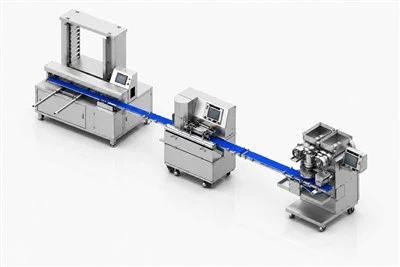
First, let’s set the scene. Labeling in cookie production isn’t a standalone task—it’s a link between the packaging line’s cookie-filling and sealing stages, and it has to sync with every other step to avoid bottlenecks. If the label doesn’t go on at the exact right speed, or if it’s not aligned with the bag’s trim, you end up with wasted product, slowed production, and extra costs. That’s why my team designs labeling systems that integrate with the rest of the line, not just tack on as an afterthought. The process unfolds in six distinct, interconnected steps, each with its own set of rules to make sure every label is accurate and compliant.
Step one is label preparation and loading, which sounds simple but is actually the foundation of a good labeling job. Before any label touches a cookie bag, it has to be organized, checked, and loaded into the labeling machine correctly. For most cookie lines, we use roll-fed labels, because they can hold more labels in a smaller footprint and feed faster than individual sheets. But here’s where precision matters: each roll of labels has to be aligned so that the machine’s sensor can pick up registration marks—tiny lines or dots printed on the edge of the label that tell the system exactly where to place it. If those marks are off, the label will be misaligned. Our techs also inspect every roll for defects: smudged ink, cut labels that are too short or too long, or adhesive that’s not evenly coated. For example, during a recent installation at a mid-sized bakery, we caught a roll of labels with a misprinted “best by” date half-way through loading, preventing hundreds of mislabeled bags before they hit the line. We also choose adhesive types based on the packaging material: if cookies are sealed in plastic bags, we use a permanent acrylic adhesive that won’t peel off on the shelf; if boxes are made of cardboard, we use a stronger rubber-based adhesive to resist moisture and rough handling. That’s a detail most suppliers overlook, but it’s what keeps labels intact long after a consumer buys the product.
Step two is label feeding and registration, where the machine takes that prepared roll and pulls labels off one at a time at the exact speed of the production line. Cookie lines typically run between 30 and 120 packages per minute, depending on the product—small, individual-wrapped shortbread might move faster, while large, deluxe cookie boxes run slower. The labeling machine’s feed mechanism, usually a set of motorized rollers, pulls the roll tight to avoid wrinkles, and a vacuum system holds the label in place as it moves toward the package. This is where the registration sensor does its work: it reads those tiny marks on the label roll to sync the label’s position with the package. If a cookie bag moves even a fraction of an inch out of position, the sensor adjusts the label feed to make sure it lines up perfectly with the bag’s corner or front panel. We’ve spent years refining this sync, so our machines have a tolerance of less than 0.5 millimeters—small enough that consumers never notice, but big enough to prevent mislabels. I remember a test run a couple years back where a new packaging material had a slight stretch, and our registration system automatically adjusted the label feed in real time, cutting waste by 15% compared to the bakery’s old labeling machine that had to stop and reset every time. That’s the kind of innovation that makes a difference for our customers.
Step three is application, where the label is actually placed onto the cookie package. There are a few different application methods depending on the package type, and I always tell customers to match the method to their product to avoid mistakes. For flexible plastic bags (the most common for snack cookies), we use a pressure-sensitive label applicator: as the bag moves along the line, the label is pressed firmly against it by a rubber roller or a vacuum head. The pressure has to be just right—too light, and the label won’t stick; too hard, and it will warp the thin plastic bag. For rigid boxes, like those holding holiday cookie assortments, we use a hot-melt adhesive that’s applied to the back of the label just before it touches the box, creating a strong bond that resists stacking and shipping. There’s also shrink sleeve labeling for products that need a full wrap, like some premium cookie tins, but that’s more specialized and requires a heat tunnel to shrink the sleeve tightly. No matter the method, the key here is timing: the applicator has to make contact with the package at the exact moment the bag or box is in the correct position, so labels never overlap or get stuck to the wrong package. Last year, a customer came to us after a supplier’s labeling system was overlapping labels, causing 20% of their cookie boxes to be rejected. We swapped in our precision applicator, and that overlap rate dropped to less than 0.1%—a huge improvement for their bottom line.
Step four is quality check and verification, which is non-negotiable in food production, especially for labels that carry critical information. Food labeling regulations in most countries (like the FDA in the U.S. and EFSA in the European Union) require labels to display exact ingredients, nutrition facts, allergen warnings, net weight, production date, and best-by date—all in specific fonts and sizes. Our labeling systems integrate two types of checks here: vision inspection and barcode verification. A high-resolution camera scans each label as it’s applied, checking for missing text, misspelled words, wrong colors, and alignment. If the camera detects a defect—say, a missing “contains wheat” allergen warning—it triggers a rejection mechanism that diverts that bad package to a holding bin, so it never leaves the line. The barcode scanner, meanwhile, makes sure the UPC or other product code is scannable at the store checkout. A barcode that’s too faint or too crooked won’t scan, and that can cause delays in the supply chain. We’ve even added an allergen check feature for customers making nut-free cookies: the system cross-references the label’s text with a pre-programmed list of allowed allergens, so a misprinted label with “may contain nuts” when it should be “nut-free” is automatically rejected. This step is what turns a good labeling process into a compliant one; skip it, and you’re looking at fines, product recalls, and damaged reputation—something no cookie producer wants.
Step five is correction and rejection, where the system fixes (or removes) any bad packages before they move on. Not every error needs a full reject, though—some misalignments can be corrected on the spot. For example, if a label is slightly off-center but all the text is correct, our system’s servo motor can adjust the position of the applicator to nudge the label into place, instead of rejecting the entire package. That cuts down on waste, which is a big win for small bakeries that operate on thin margins. If the error is uncorrectable—missing text, wrong barcode, misprinted date—the package is diverted to a reject bin, and the machine alerts the operator so they can fix the root cause. Maybe the label roll is running low, or the registration mark got smudged, or the camera needs a quick calibration. We design our systems with user-friendly interfaces so operators can spot issues fast and make adjustments without stopping the whole line for long. I once worked with a customer who had a reject rate of 5% before switching to our system; after adding the correction feature, their reject rate dropped to 1.2%, saving them thousands of dollars in wasted cookies and labels each month.
Step six is line integration and post-labeling tracking, which ties the entire process together with the rest of the production line and supply chain. Once the label is applied and verified, the cookie package moves to the sealing or case-packing stage, and the labeling system shares data with those downstream machines. That data includes how many labels were used, how many packages were rejected, and even which product is being labeled at which time—information that’s critical for production planning and traceability. If a batch of cookies has a production issue, a producer can pull the labeling system’s records to see exactly when that batch was made and which packages are affected, making recalls much faster and less costly. We also offer cloud-based tracking for customers who want to monitor their lines remotely; they can check the labeling speed, reject rate, and label inventory from their office or even a phone, so they never miss a problem. This integration is what makes our labeling systems different from off-the-shelf models—it’s not just a machine that sticks labels; it’s a tool that keeps the entire production line running smoothly.
Now, you might be wondering why this matters for your cookie purchase. That perfect label you grab at the store is the end result of every one of these steps, all working in sync. For a bakery, the labeling process is a balance between speed (to meet demand), accuracy (to avoid fines), and cost (to keep prices reasonable). As a supplier, my team doesn’t just sell machines—we design systems that fit each customer’s unique needs, whether they’re making 1,000 cookies a day or 100,000. We work with them to pick the right label type, applicator method, and inspection tools, because a one-size-fits-all approach never works in food production.
If you’re a cookie producer looking to upgrade your labeling process, or if you’re just starting out and want to make sure your product gets to market right, we’re here to help. We don’t just install machines—we provide training, ongoing support, and custom adjustments to make sure your labeling line works as hard as you do. To learn more about how our cookie production line labeling systems can fit your facility, reach out to our team to discuss your specific needs and get a personalized consultation.
Flatbread Production Line References:
- Food and Drug Administration. (2022). Food Labeling Guide: Compliance Manual. U.S. Department of Health and Human Services.
- European Food Safety Authority. (2021. Regulation (EU) No 1169/2011 on the provision of food information to consumers. EFSA Journal.
- Packaging Machinery Manufacturers Institute. (2020. The Complete Guide to Food Packaging Line Integration. PMMI Media Group.
- Smith, J. (2019. Precision Labeling for Food Production: Reducing Waste and Ensuring Compliance. Journal of Food Engineering.
- National Food Processors Association. (2022. Operational Best Practices for Cookie and Bakery Production Lines. NFPA.
Shanghai Longyu Electro-Mechanic Technology Co., Ltd.
Shanghai Longyu Electro-Mechanic Technology Co., Ltd. is one of the most professional cookie production line manufacturers and suppliers in China, featured by quality products and good service. Please feel free to wholesale advanced cookie production line made in China here from our factory. Also, custom service is available.
Address: No.66, Guangfulin East Road, Zhongshan Subdistrict, Songjiang District, Shanghai, China
E-mail: sales4@longyu-sh.com
WebSite: https://www.longyu-sh.com/
