Hey there! If you’ve ever walked past a construction site, a drainage project, or even the underbelly of your local neighborhood’s utility lines, you’ve probably stumbled on those bendy, ridged plastic pipes—you know the ones, corrugated, light but tough, way easier to haul around than old metal or concrete. Ever wondered how those things are made at scale? As someone who’s been supplying plastic corrugated pipe machines for over 10 years, I get this question all the time from contractors, new plant owners, and even curious hobbyists who stumble on our site. Let’s break it down like I would over a coffee at a trade show, no jargon, just the real deal. Plastic Corrugated Pipe Machine

First off, let’s cut to the core: a plastic corrugated pipe machine isn’t some fancy, unapproachable lab equipment. It’s a system of linked parts that take raw plastic, melt it, shape it into a continuous tube, and then stamp those corrugations (the ridges and grooves) on it before it cools into something solid enough to ship. Most folks I chat with think it’s just extruding plastic and then pressing ridges on it, but there’s a lot of fine-tuning to get right otherwise you end up with lopsided pipes that crack under pressure or collapse when you’re digging them in.
Let’s start with what goes in first: raw material. 9 out of 10 times, we work with HDPE (high-density polyethylene) or PVC for these machines, because they’re cheap, flexible, durable, and don’t rot like metal or concrete. Sometimes customers mix in a bit of recycled plastic these days, which works great as long as we adjust the machine settings to account for any impurities or inconsistent viscosity from the regrind. No point in running cheap if your pipes fall apart, right? That’s why we always test your specific material before shipping you a machine, even if it’s standard HDPE.
Next up is the extruder—this is the heart of the whole operation. Think of it like a really big, heated, spiraled meat grinder, but instead of beef, it’s plastic pellets. The extruder has a long barrel with a rotating screw inside, and along the barrel, there are heating zones that warm the pellets up gradually, not all at once. We start at around 150C at the feed hopper (where you pour in pellets) and crank it up to like 220-240C at the end, where the melted plastic comes out. The gradual heating is key—if you blast the plastic too hot too fast, it burns, gets foamy, or turns brittle. I’ve seen new operators skip this step and waste hours of downtime fixing the mess. The screw isn’t just turning for fun, either: it pushes the melted plastic forward, applies pressure, and mixes it so it’s smooth and consistent, no lumps or air bubbles. That consistency is everything—if the melted plastic coming out of the extruder is uneven, the finished pipe will have thin spots that break.
Once the melted plastic leaves the extruder, it goes through a die. The die is a custom-shaped metal part, not some random block—for corrugated pipe, it’s usually a circular die with a narrow opening, so the plastic comes out as a hollow, continuous tube (we call this the parison). Wait a second—you can’t just send this soft tube out into the open, right? It would collapse on itself before you can shape the corrugations. That’s where the vacuum calibrator comes in, right after the die. The calibrator is a long, cool metal tank with tiny holes all along the top and sides. We suck air out of the inside of the calibrator, which creates a vacuum that pulls the soft plastic parison tight against the inner walls of the calibrator. That keeps the tube round, with a consistent outer diameter, as it starts to cool a little. No vacuum, no round pipe—simple as that.
Now the fun part: adding the corrugations. This is where the corrugator comes in, and it’s two sets of interlocking metal belts (or sometimes two matching mold wheels, depending on the pipe size) lined with custom-shaped ridges and grooves. Here’s how it works: the soft, slightly cooled pipe from the calibrator gets pulled between these two belts, which are heated just enough to keep the plastic pliable but not melting it completely. The belts close tight around the pipe, stamping those repeating ridges and grooves—corrugations—into it. The cool thing here is that the corrugations don’t have to be a set size; we design the belts or wheels to match whatever pipe size you need, from tiny 2-inch pipes for residential drainage to 12-inch or bigger for municipal projects. Some machines even let you swap out the belts in like 15 minutes if you need to switch pipe sizes on a job, which is a huge time-saver for guys who do different projects.
Wait, also—do all corrugated pipes have a single wall or a double wall? Right, that’s a big difference I should mention. Single-wall is just the outer ridged layer, used for things like underground drainage or cable protection where flexibility isn’t the top priority. Double-wall has an inner smooth layer too, which is way stronger, can hold more pressure, and is used for things like sewer lines or stormwater pipes. For double-wall, the machine has an extra extruder that feeds a second stream of melted plastic, which forms the inner smooth wall while the outer extruder feeds the corrugated outer wall. The corrugator still stamps both layers together at the same time, so they bond perfectly before cooling. A lot of new customers don’t even realize they can get both setups from the same base machine, as long as we adjust the extruder setup.
After the corrugations are stamped, the pipe is still soft, so it goes through a cooling tank next. This is usually a long tank full of cool water (or sometimes air for extra-large pipes, but water is cheaper and works better for most stuff) that brings the temperature of the plastic down to like 20-30C, where it’s rigid enough not to deform. We add a slight pull to the whole system here, too—there’s a caterpillar-style puller (think of two rubber belts squeezing the pipe and pulling it at a steady speed) that keeps the pipe moving at a consistent rate. If the puller moves too fast, the pipe gets stretched thin; too slow, it piles up like a slinky and collapses. I always tell new operators to calibrate the puller speed first thing when they start a run—most problems with finished pipes come from a bad puller setting, not the machine itself.
Once the pipe is cooled and moving steadily, it goes through a cutting station. This is a sharp blade (usually a circular saw or a flying cutter, depending on how long the pipes need to be) that cuts the continuous length of pipe into 20-foot or 40-foot sections, which is standard for shipping. Some bigger plants use coil cutters for really long runs, so the pipe is wound into coils instead of cut into straight sections, which is way easier to transport for small jobs. After cutting, we have a sorting station that checks for defects—thin spots, uneven corrugations, air bubbles—and then it’s ready to ship off to the job site.
Now, before I wrap up, let’s talk about what makes a good corrugated pipe machine, because that’s what all our customers care about. A lot of cheap machines you’ll find online cut corners on heating, or the corrugator belts are flimsy, so they break after a week. We build ours with variable heating zones, so you can adjust the temperature exactly for your material, even if you’re using recycled plastic, and the corrugator belts are made from high-grade steel that can handle thousands of runs without wearing out. Also, we include things like automatic thickness gauges that adjust the extruder screw speed if the pipe is getting too thin or too thick, so you don’t have to baby the machine all day.
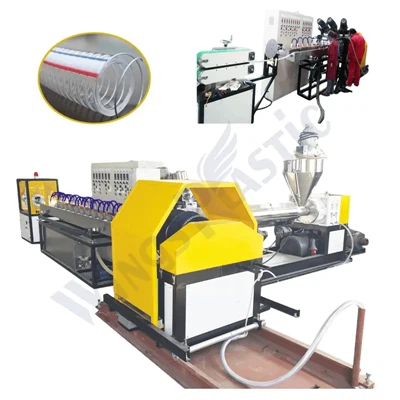
If you’re a contractor looking to set up your own pipe yard, or a plant owner looking to upgrade your current line, hit me up. We don’t do generic machines—we tailor each setup to what you need, whether that’s small residential drainage pipes or big municipal sewer lines. No hidden fees, no weird fine print, just straight talk and machines that work as hard as you do.
HDPE Pipe Machine REFERENCES
Plastic Extrusion Technology, 5th Edition, Hanser Gardner Publications
HDPE Pipe Manufacturing Process: A Practical Guide, American Society of Civil Engineers
Corrugated Pipe Machinery Design and Operation Manual, Extrusion Industry Association
Qingdao Wings Plastic Technology Co., Ltd.
As one of the most experienced plastic corrugated pipe machine manufacturers and suppliers in China, we also support customized service. Please feel free to buy durable plastic corrugated pipe machine made in China here from our factory. For price consultation, contact us.
Address: C02 Of Anshengyi Road, No.2 Fuan Industry Zone,Jiaodong Town, Jiaozhou City, Qingdao City, Shandong Province,China
E-mail: kelly@wingsplastic.com
WebSite: https://www.wingsextruder.com/
